Introduction:
https://textileinfo.net/how-sustainable-fabrics-are-produced/Textile Recycling: Process, Benefits and Future. Textile recycling is becoming an important part of the global effort to reduce waste, conserve natural resources, and build a more sustainable fashion and manufacturing industry. Every year, millions of tonnes of clothing, fabrics, carpets, and other textile products reach the end of their useful lives. Much of this material could be reused or recycled instead of being sent to landfills or incinerators.
For the textile industries in the United States and Europe, recycling is no longer just an environmental issue. It is also creating opportunities for manufacturers, fashion brands, recycling companies, material innovators, and consumers.
New technologies are helping transform discarded fabrics into useful fibres and materials. At the same time, governments are introducing policies that encourage more responsible textile production and waste management.
In this guide, we explain how textile recycling works, the main recycling methods, its environmental and economic benefits, the challenges facing the industry, and what the future may look like.
What Is Textile Recycling?
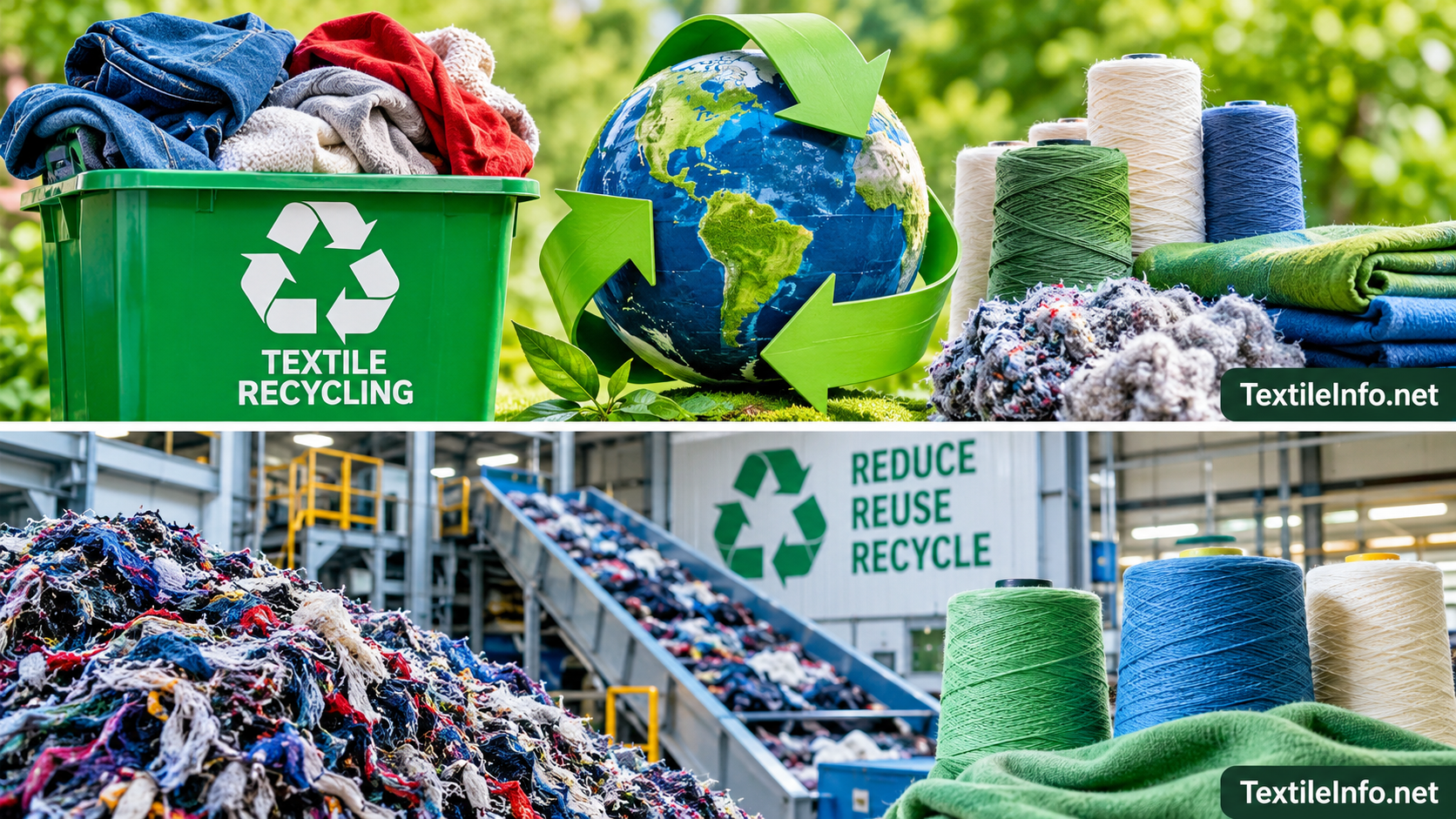
Textile recycling is the process of collecting used or unwanted textile materials and converting them into reusable products, fibres, yarns, or other useful materials.
These materials can come from different sources, including:
- Old clothes and footwear
- Factory fabric scraps
- Unused or unsold garments
- Damaged household textiles
- Curtains, bedsheets, and towels
- Carpets and upholstery
- Industrial textile waste
Textile recycling helps keep valuable materials in circulation for longer. Instead of depending entirely on newly produced cotton, polyester, wool, or other fibres, manufacturers can use recovered materials as part of their production process.
However, recycling is not always the first or best option. Clothing that is still wearable may create more value when it is repaired, donated, or resold. Recycling is particularly important for textiles that cannot reasonably be reused.
Why Is Textile Recycling Important?
https://textileinfo.net/global-textile-industry/The global fashion and textile industries use large quantities of raw materials, water, energy, and chemicals. Their products also generate waste during manufacturing, distribution, and everyday use.
The European Commission identifies textiles as a major area of environmental pressure, particularly in relation to water, land use, raw materials, and greenhouse gas emissions. Its circular textiles strategy aims to make products more durable, repairable, and recyclable.
Textile recycling can help address several problems:
Reducing textile waste: Recycling gives unwanted fabrics another use and can reduce the amount of material sent to disposal facilities.
Conserving raw materials: Recovered fibres can reduce demand for some virgin materials, depending on the recycling method and final product.
Supporting circular fashion: Recycled materials help manufacturers move towards a system in which products and resources remain in use for longer.
Encouraging innovation: Demand for recycled fibres is creating opportunities for new machinery, sorting systems, and recycling technologies.
The Textile Recycling Process: Step by Step
https://textileinfo.net/sustainable-textiles-eco-friendly-fabrics-future/Textile recycling involves several stages. The exact process depends on the fabric type, condition, fibre composition, and the required quality of recycled material.
1. Collection of Used Textiles
The first stage is collecting unwanted textile products from consumers, manufacturers, retailers, and other sources.
Common collection methods include:
- Clothing donation centres
- Textile recycling bins
- Retailer take-back programmes
- Municipal collection systems
- Factory waste collection
- Commercial textile recovery services
Manufacturing waste is often easier to recycle because its fibre composition and production history may be known. Post-consumer clothing can be more difficult to process because it may contain different materials, stains, buttons, zippers, coatings, and accessories.
2. Sorting and Inspection
After collection, textiles are transported to sorting facilities.
Workers and automated systems inspect the materials and separate them according to:
- Fibre type
- Colour
- Fabric construction
- Condition
- Reuse potential
- Recycling suitability
Wearable clothing may be selected for resale or donation. Damaged or unsuitable textiles may move to recycling.
Modern sorting facilities increasingly use optical scanners, artificial intelligence, and automated identification technologies to recognise different textile materials. Better sorting can improve the quality and efficiency of recycling operations.
3. Removing Accessories and Contaminants
Before recycling begins, remove unsuitable components.
These can include:
- Buttons
- Zippers
- Metal fasteners
- Plastic decorations
- Labels
- Elastic components
- Non-textile attachments
Removing these materials helps prepare the textile for processing. It is particularly important when a recycling system is designed to recover specific fibres.
4. Shredding and Fibre Separation
In mechanical recycling, selected textiles are cut or shredded into smaller pieces. Special machines then open the fabric structure and separate it into individual fibres.
The recovered fibres can be cleaned, blended with other fibres, and processed into new yarn.
One limitation is that mechanical processing can shorten or damage fibres. This may reduce the strength and quality of the resulting yarn, which is why recycled fibres are sometimes mixed with virgin fibres.
5. Fibre Cleaning and Processing
Recovered fibres may contain dust, dyes, finishes, and other unwanted substances.
Depending on the material and recycling technology, additional cleaning and processing steps may be required.
The objective is to produce fibres that meet the requirements of the next manufacturing stage.
6. Spinning New Yarn
After processing, suitable fibres can be converted into yarn through spinning.
Manufacturers may use recycled fibres alone or combine them with virgin fibres to achieve the required strength, appearance, and performance.
The yarn can then be used to produce different textile products, including clothing, bags, upholstery, and industrial fabrics.
7. Manufacturing New Products
The final stage is converting recycled yarn or recovered material into new products.
Examples include:
- Recycled cotton T-shirts
- Recycled polyester sportswear
- Denim products
- Home furnishings
- Carpet materials
- Insulation products
- Industrial textiles
- Nonwoven materials
The result is a new product made partly or entirely from recovered textile resources.
Main Types of Textile Recycling
There are several textile recycling methods. The most suitable approach depends on the material and the intended application.
1. Mechanical Textile Recycling
Mechanical recycling uses physical processes to break textiles down into fibres without dissolving the material chemically.
Typical operations include cutting, shredding, opening, cleaning, and fibre preparation.
Common applications:
- Recycled cotton yarn
- Nonwoven fabrics
- Mattress filling
- Insulation materials
- Cleaning cloths
- Automotive textiles
Advantages:
- Established processing methods
- Can be suitable for relatively clean, single-fibre materials
- Often less chemically intensive than chemical recycling
Limitations:
- Fibres can become shorter and weaker
- Blended fabrics are difficult to separate
- Recycled material may have limited applications
2. Chemical Textile Recycling
Chemical recycling uses chemical or solvent-based processes to separate, dissolve, or recover components from textile materials.
Different technologies are designed for different fibres. For example, some processes can recover polyester building blocks, while others aim to dissolve and regenerate cellulosic fibres.
The recovered material can potentially be used to manufacture new fibres.
Common applications:
- Polyester recovery
- Cellulose-based fibre regeneration
- Selected blended-fabric recycling processes
Advantages:
- Can offer higher-quality material recovery for suitable feedstocks
- Some technologies can process selected fibre blends
- May support fibre-to-fibre recycling
Limitations:
- Requires specialised equipment and processing conditions
- Can involve significant investment
- Chemical use, energy consumption, and wastewater management must be carefully controlled
- Commercial performance varies between technologies
3. Thermal and Energy Recovery
Some textile waste is processed through thermal treatment, including energy recovery systems.
This approach can recover energy from waste, but it does not return the original textile fibres to the manufacturing cycle.
For that reason, energy recovery should not be confused with fibre-to-fibre recycling.
4. Upcycling and Downcycling
Upcycling transforms discarded textiles into products with a new or higher-value use without necessarily returning them to fibre form.
Examples include turning old denim into bags or converting fabric scraps into decorative products.
Downcycling converts textile waste into materials with different or generally lower-value applications, such as insulation or stuffing.
Both approaches can extend material use, although neither necessarily creates new textile fibres.
Mechanical vs Chemical Textile Recycling
| Feature | Mechanical recycling | Chemical recycling |
|---|---|---|
| Main approach | Physical fibre recovery | Chemical or solvent-based processing |
| Suitable materials | Many clean, compatible textiles | Selected fibres and blends |
| Fibre quality | Can decrease during processing | Can preserve or recover useful material properties in suitable processes |
| Equipment | Shredding and fibre-opening machinery | Specialised chemical processing systems |
| Main challenge | Fibre damage and mixed materials | Cost, process control, and environmental management |
| Typical output | Recycled fibres and nonwovens | Recovered polymers or regenerated fibre materials |
Neither method is suitable for every textile. The best choice depends on fibre composition, contamination, processing costs, and the quality required for the final product.
Environmental Benefits of Textile Recycling
Textile recycling can provide important environmental benefits when collection and processing are properly managed.
1. Reduces Landfill Waste
Discarded clothing and other textiles take up valuable landfill space. Recovering suitable materials can reduce the quantity of textile waste requiring disposal.
2. Conserves Natural Resources
Producing new fibres requires raw materials. Reusing recovered cotton, polyester, and other fibres can reduce demand for some virgin resources.
The actual savings depend on the material, recycling technology, and product being manufactured.
3. Can Reduce Greenhouse Gas Emissions
Producing recycled fibres may have a lower environmental impact than producing equivalent virgin materials in some applications.
However, the result depends on collection, transportation, processing energy, chemicals, and the quality of the recovered material. Recycling is not automatically carbon-neutral.
4. Supports Water Conservation
Some recycled textile production routes may require less water than producing equivalent virgin materials.
For example, using recovered fibres can avoid certain stages of raw material cultivation or production. Actual water savings vary significantly between processes.
5. Encourages Circular Fashion
Circular fashion focuses on designing, producing, using, repairing, reusing, and recycling clothing in a way that keeps resources in circulation.
Textile recycling is one part of this wider approach.
Economic Benefits of Textile Recycling
Textile recycling is also creating opportunities across the global textile supply chain.
New business opportunities: Companies can develop textile collection, sorting, recycling, and recycled-material manufacturing services.
Employment opportunities: Recycling facilities require workers for collection, inspection, sorting, machinery operation, maintenance, and quality control.
Lower dependence on virgin materials: Recovered fibres can provide an additional source of raw materials, although their availability, price, and quality vary.
Product innovation: Fashion brands and textile manufacturers can develop products using recycled materials to meet customer and business requirements.
Supply chain resilience: A stronger recycling sector can diversify material sources and support more local or regional resource recovery.
Textile Recycling in the United States
The United States is an important market for textile consumption, fashion, and recycling innovation.
However, building a large-scale textile circular economy remains challenging. Collection networks, sorting capacity, recycling infrastructure, and the economics of processing mixed textile waste all influence the industry’s development.
A 2026 report from the U.S. Government Accountability Office identifies potential benefits such as new jobs and markets, while highlighting limited funding and domestic infrastructure as important challenges.
Several areas are important for the US market:
- Clothing collection and reuse programmes
- Textile sorting and material identification
- Recycled polyester and cotton development
- Investment in recycling facilities
- Brand-led take-back initiatives
- Better product design for recycling
For American fashion brands and manufacturers, recycled materials may become an increasingly important part of product development and supply chain planning.
Textile Recycling in Europe
Europe is playing an important role in developing policies and technologies for a more circular textile industry.
The European Union’s Strategy for Sustainable and Circular Textiles aims to improve textile durability, repairability, recyclability, and resource efficiency.
An important policy development is the revised Waste Framework Directive, which entered into force in October 2025. It introduces common rules for extended producer responsibility (EPR) schemes for textiles and footwear across EU Member States. These schemes are intended to help finance the management of products after use, including reuse and recycling. Implementation takes place through national systems.
For European textile companies, important areas include:
- Separate collection of used textiles
- Better sorting and reuse systems
- Investment in textile recycling capacity
- Recycled fibre development
- Product design for durability and recycling
- Compliance with relevant national and EU requirements
The European Environment Agency has also highlighted the need to expand sorting and recycling capacity so that separately collected textiles can be managed effectively.
Challenges Facing the Textile Recycling Industry
Despite its potential, textile recycling still faces several technical and commercial difficulties.
1. Mixed Fibre Fabrics
Many garments contain blends such as cotton and polyester. Separating these fibres can be difficult and expensive.
2. Fibre Quality Loss
Mechanical recycling can shorten fibres, making it harder to produce strong, high-quality yarn.
3. High Processing Costs
Collection, transportation, sorting, cleaning, and recycling require investment. Recycled fibres must also compete with virgin materials on price and performance.
4. Limited Recycling Infrastructure
Many regions do not yet have enough specialised facilities to process large quantities of textile waste.
5. Dyes, Finishes, and Contamination
Chemical finishes, coatings, stains, and mixed materials can complicate recycling and affect the quality of recovered fibres.
6. Consumer Awareness
Consumers may not know how to separate, donate, repair, or recycle unwanted clothing. Clear collection instructions and accessible programmes are important.
7. Demand for Recycled Materials
Recycling businesses need reliable buyers for the materials they produce. Without consistent demand, investment in new facilities can be difficult to justify.
The Future of Textile Recycling
The future of textile recycling will depend on better technology, smarter product design, stronger collection systems, and cooperation between manufacturers, brands, governments, and consumers.
Several developments are likely to shape the industry.
1. AI-Powered Textile Sorting
Artificial intelligence and advanced sensors can help identify fibre types, colours, and materials.
Automated sorting systems may improve processing speed and accuracy, helping facilities handle larger quantities of textile waste.
2. Advanced Fibre-to-Fibre Recycling
New mechanical and chemical technologies are being developed to recover useful fibres from materials that are difficult to recycle using traditional processes.
Improved treatment of cotton-polyester blends could be particularly important for the future of textile recycling.
3. Textile Products Designed for Recycling
Manufacturers can make recycling easier by choosing compatible fibres, reducing unnecessary blends, and designing garments that are easier to disassemble.
Durability and repairability should also be considered during product development.
4. Digital Product Information
Digital product information systems, including the EU’s developing Digital Product Passport framework, may help businesses access information about textile materials, composition, and product characteristics.
Better information can support sorting, repair, reuse, and recycling decisions. The exact requirements and timelines depend on the relevant EU rules.
5. Growth of Recycled Textile Markets
Demand for recycled fibres may create opportunities for textile mills, fashion brands, sportswear manufacturers, and industrial textile producers.
Commercial growth will depend on reliable quality, competitive pricing, and transparent environmental claims.
6. Stronger Producer Responsibility
Extended producer responsibility programmes can encourage companies to consider what happens to products after consumers finish using them.
These systems may help fund collection, sorting, reuse, and recycling infrastructure.
How Textile Manufacturers Can Adopt Recycling
Textile manufacturers can take practical steps to become more involved in recycling.
- Audit textile waste: Measure the amount and types of waste generated during production.
- Separate materials: Keep cotton, polyester, and other fibre streams apart where practical.
- Reduce production waste: Improve cutting efficiency and optimise fabric use.
- Work with recycling partners: Build relationships with qualified collection and processing companies.
- Use recycled raw materials: Test suitable recycled fibres in selected products.
- Improve product design: Reduce unnecessary fibre blends and make products easier to repair and recycle.
- Verify environmental claims: Use reliable documentation and relevant certification or testing systems.
These steps can help manufacturers reduce waste, improve resource efficiency, and prepare for changing customer and regulatory expectations.
How Consumers Can Support Textile Recycling
Consumers also play an important role in reducing textile waste.
Here are practical ways to help:
- Buy durable clothing that can be used for longer.
- Repair damaged garments when possible.
- Donate clean, wearable clothes.
- Use reliable textile collection programmes.
- Follow local recycling instructions.
- Choose products containing verified recycled materials.
- Avoid purchasing clothing that is unlikely to be used.
- Consider secondhand clothing before buying new products.
Remember that donating wearable clothing for reuse is often preferable to recycling it immediately.
Frequently Asked Questions About Textile Recycling
What is textile recycling?
Textile recycling is the process of recovering used or unwanted textile materials and converting them into reusable fibres, yarns, fabrics, or other products.
What are the main types of textile recycling?
The main approaches include mechanical recycling, chemical recycling, upcycling, and downcycling. Thermal energy recovery is another form of waste treatment, but it does not recover textile fibres for new fabric production.
Can cotton fabric be recycled?
Yes. Cotton fabric can be mechanically recycled into fibres that may be used in new yarns, nonwoven materials, insulation, and other products. Fibre length and quality can decrease during processing.
Can polyester fabric be recycled?
Yes. Polyester can be recycled through mechanical or chemical processes, depending on its form and the available technology. Recycled polyester is commonly used in clothing, bags, and other textile products.
Can blended fabrics be recycled?
Some blended fabrics can be recycled, but separating their different fibres is often difficult. New technologies are being developed to improve the recovery of materials from blended textiles.
Is textile recycling environmentally friendly?
Textile recycling can reduce waste and demand for virgin materials. However, its overall environmental benefit depends on the collection system, transport, energy use, chemicals, processing technology, and final application.
What is the difference between textile reuse and textile recycling?
Reuse means using a product again, often through resale, donation, or repair. Recycling involves processing its materials into fibres or other resources for new applications.
What is the future of textile recycling?
The future is likely to include AI-powered sorting, improved fibre-to-fibre recycling, better product design, digital material information, and stronger producer responsibility programmes.
Conclusion
Textile recycling is becoming an essential part of the transition towards a more sustainable global textile industry. By collecting, sorting, and processing unwanted fabrics, businesses can recover valuable resources and create new opportunities for textile manufacturing.
Although challenges such as mixed fibres, processing costs, and limited infrastructure remain, advances in mechanical recycling, chemical technologies, and automated sorting are creating new possibilities.
The United States and Europe have important roles to play through investment, innovation, consumer participation, and supportive policies. Textile manufacturers and fashion brands can also contribute by designing durable products and using recycled materials where technically and commercially suitable.
The future of the textile industry will not depend only on producing new fabrics. It will also depend on how effectively the industry reuses, repairs, and recovers the materials it already has.
Textile recycling is more than a waste-management solution. It is an important step towards a circular and resource-efficient textile industry.