Introduction:
EU Digital Product Passport for Textiles: Manufacturer Guide. The European textile and fashion industry is moving towards greater transparency, traceability, and sustainable production. One of the most important developments behind this transformation is the EU Digital Product Passport (DPP).
https://textileinfo.net/smart-textile-factories/The Digital Product Passport is designed to make important product information available throughout a product’s lifecycle. It will help consumers, manufacturers, importers, retailers, repair businesses, and recycling companies access information about products and the materials used to make them.
For textile manufacturers and fashion brands selling products in Europe, this development could significantly change how product information is collected, stored, shared, and verified.
It also matters to manufacturers outside Europe. Companies in the United States, Bangladesh, India, China, Vietnam, Turkey, and other textile-producing countries may need to provide relevant product information when supplying goods to the European Union.
But what exactly is the EU Digital Product Passport? How will it affect textile manufacturers? What information might be required, and how can businesses prepare?
This guide explains the system, its expected requirements, the implementation timeline, business implications, and practical preparation steps.
What Is the EU Digital Product Passport?
https://textileinfo.net/global-textile-industry/The EU Digital Product Passport is a digital information system that connects a physical product to information about its identity, materials, characteristics, and other relevant details.
Under the Ecodesign for Sustainable Products Regulation (ESPR), the passport is intended to improve product transparency and support a more circular economy.
For textile products, a Digital Product Passport could provide information about:
- Fibre composition
- Product identification
- Material origin
- Manufacturing information
- Product durability
- Care and maintenance
- Repair and reuse
- Recycled material content
- End-of-life treatment
- Recycling and disposal information
- Relevant compliance documentation
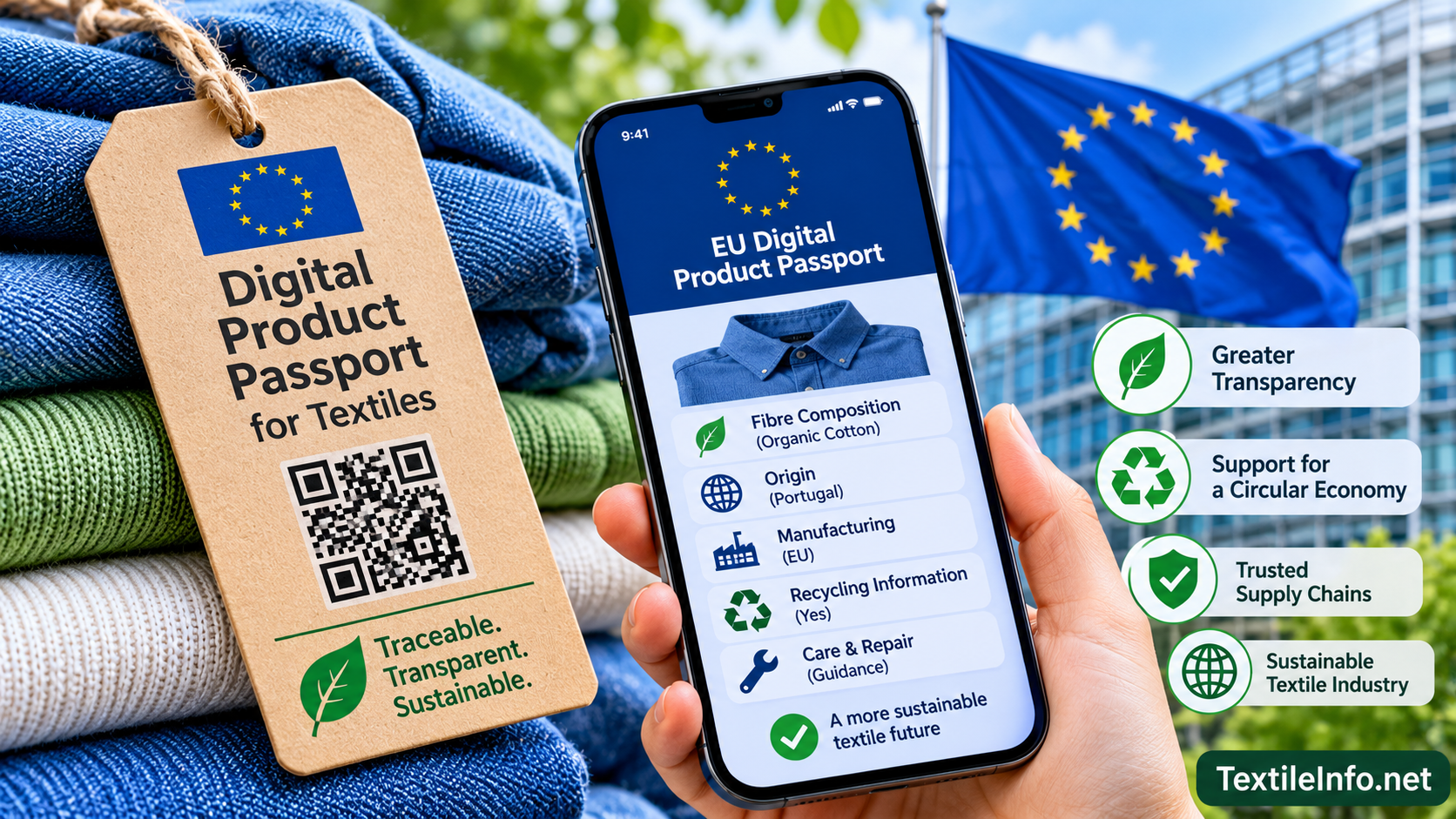
The information will be accessible through a digital data carrier, such as a QR code, attached to or associated with the product.
For example, a consumer purchasing a jacket could scan its QR code to access available information about its fabric composition, care instructions, and other product details.
A recycling company could use relevant passport information to understand which materials are present and how the product may be handled at the end of its useful life.
The exact mandatory information for textile products will depend on the future textile-specific EU rules.
Why Is the EU Introducing Digital Product Passports?
https://textileinfo.net/textile-recycling-process-benefits-future/The textile industry has a complex international supply chain. A single garment may involve raw material suppliers, spinning mills, fabric manufacturers, dyeing facilities, garment factories, shipping companies, distributors, and retailers located in different countries.
Important product information is often stored in separate systems, spreadsheets, certificates, and supplier documents.
This can make it difficult to verify product claims or obtain accurate information throughout the supply chain.
The EU Digital Product Passport aims to address these challenges.
1. Greater Product Transparency
Consumers and business customers increasingly want to understand what products are made from and how they are produced.
A digital passport can make relevant information easier to access without relying entirely on printed labels.
2. Better Supply Chain Traceability
Manufacturers and brands can use structured product information to connect materials, suppliers, production facilities, and finished products.
This can improve visibility across international supply chains.
3. Support for Sustainable Production
Better information about materials, durability, and environmental characteristics can help businesses make more informed product-design and sourcing decisions.
4. Improved Repair and Reuse
Information about materials and product construction can help repair businesses and secondhand retailers understand how to handle products.
5. More Effective Textile Recycling
Recycling companies need reliable information about fibre composition and material combinations.
A Digital Product Passport could make this information easier to access and support better sorting and recycling decisions.
6. Stronger Regulatory Transparency
Digital product information can help authorities access relevant compliance and traceability information when required.
The broader EU DPP system is intended to support transparency, circularity, and the enforcement of product rules.
What Is the Legal Framework Behind the EU Textile DPP?
The main legal foundation is the Ecodesign for Sustainable Products Regulation (ESPR), Regulation (EU) 2024/1781.
The regulation establishes a framework for introducing product-specific ecodesign requirements and Digital Product Passports for selected product groups.
It entered into force in July 2024.
Textiles and apparel are included among the priority product groups in the European Commission’s ESPR Working Plan for 2025–2030.
However, there is an important distinction:
The ESPR framework is already law, but the detailed textile-specific DPP requirements are still being developed.
The European Commission plans to adopt the textile-specific delegated act in the fourth quarter of 2027, according to its current published indicative timeline.
That delegated act will establish the relevant requirements for textile products, including the specific information that must be included in the passport.
The final rules may also clarify which textile products are covered, the applicable data requirements, and the transition period for businesses.
Manufacturers should therefore avoid treating proposed data fields or draft technical recommendations as final legal obligations.
EU Digital Product Passport Timeline for Textiles
Understanding the timeline is important for manufacturers, exporters, and fashion brands planning their compliance strategies.
Here is the current indicative timeline as published by the European Commission.
| Development | Indicative timing |
|---|---|
| ESPR Regulation enters into force | July 2024 |
| ESPR Working Plan 2025–2030 published | April 2025 |
| Development of textile-specific requirements | 2025–2027 |
| Planned adoption of textile delegated act | Q4 2027 |
| Technical guidance and implementation development | Following adoption |
| Application of textile-specific requirements | To be confirmed by the final legislation |
The ESPR generally provides for a transition period of at least 18 months after a delegated act enters into force. However, the final textile rules and any specific provisions must be checked.
This means businesses should not assume that textile DPP obligations become mandatory for every product immediately in 2027.
The actual application date will depend on the final legal act.
Important: The European Commission’s timeline is indicative and may change. Manufacturers should monitor official updates rather than rely on unofficial countdowns or fixed compliance dates.
What Information Could a Textile Digital Product Passport Contain?
The final textile-specific delegated act will determine the mandatory data fields.
Based on the ESPR framework and the European Commission’s current textile DPP information, manufacturers should consider preparing the following categories of product information.
1. Product Identification
Every product covered by the rules will need an appropriate identification system.
Potential information includes:
- Product name
- Product model
- Product type
- Product reference number
- Unique product identifier
- Relevant product category
- Product batch or production information, where applicable
Product identification helps connect the physical item with its digital information.
2. Fibre Composition
Fibre composition is one of the most important information categories for textile products.
Examples include:
- Cotton
- Polyester
- Wool
- Linen
- Nylon
- Viscose
- Lyocell
- Elastane
- Recycled fibres
For blended fabrics, manufacturers should maintain accurate information about the proportion of each fibre.
This information is particularly important for textile sorting, recycling, and material recovery.
It is also important to understand that fibre-composition labelling is already subject to separate EU legislation under Regulation (EU) No 1007/2011. The future DPP does not replace existing textile labelling requirements.
3. Material Origin
Product-origin information may help businesses understand where materials and products come from.
Manufacturers should consider maintaining records about:
- Raw fibre suppliers
- Yarn suppliers
- Fabric manufacturing facilities
- Dyeing and finishing facilities
- Garment production locations
- Relevant sourcing documentation
The exact origin information required in a textile passport will depend on the final rules.
4. Manufacturing Information
Manufacturing information can help establish a clearer picture of how a textile product moves through the supply chain.
Relevant records may include:
- Manufacturing facility identification
- Production stages
- Supplier information
- Product specifications
- Quality-control records
- Applicable compliance documentation
Not every manufacturing detail will necessarily become public. Access to passport information may differ according to the user and the applicable legal requirements.
5. Sustainability and Environmental Information
Sustainability information is an important part of the broader ESPR framework.
Depending on the final textile requirements, relevant information could relate to:
- Recycled material content
- Product durability
- Repairability
- Resource efficiency
- Relevant environmental performance information
- Applicable sustainability documentation
Businesses should make sure environmental claims are supported by reliable evidence.
A QR code or Digital Product Passport does not automatically make a product sustainable.
6. Care and Maintenance Instructions
Digital product information could help consumers understand how to maintain textile products correctly.
Possible information includes:
- Washing instructions
- Drying instructions
- Ironing recommendations
- Cleaning restrictions
- Maintenance guidance
- Repair instructions
Clear care information can help consumers extend the useful life of clothing and other textile products.
7. Reuse, Repair, and Recycling Information
The passport could also support businesses involved in product reuse and end-of-life management.
Relevant information may include:
- Repair guidance
- Material separation information
- Reuse recommendations
- Recycling suitability
- Disassembly instructions
- End-of-life handling information
This could become particularly useful as textile recycling technologies and circular fashion systems develop.
How Does a Digital Product Passport Work?
The Digital Product Passport connects a physical product with a digital record.
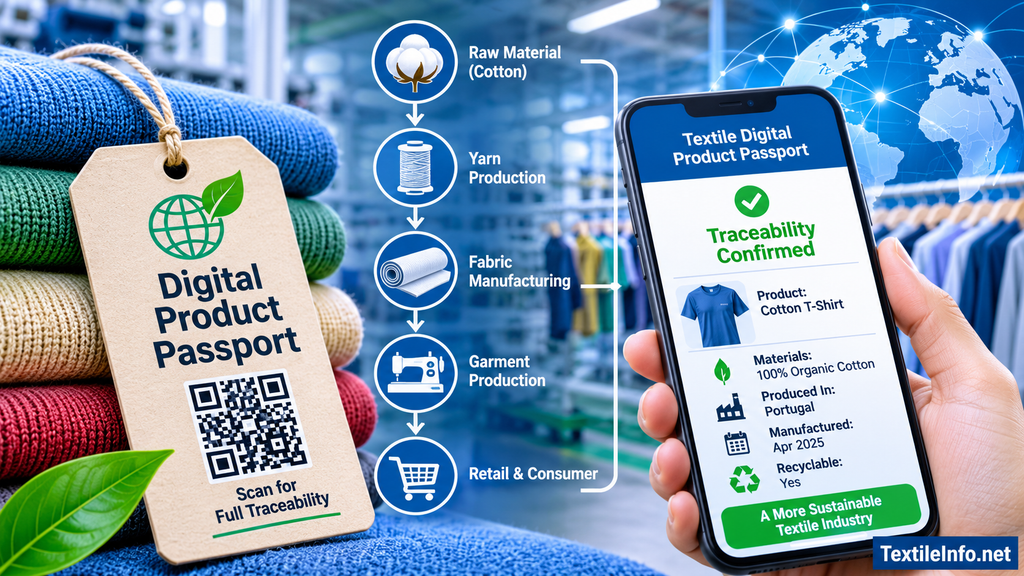
A typical process can be understood in five stages.
Step 1: Collect Product Information
The manufacturer gathers relevant information from suppliers, production facilities, laboratories, and internal business systems.
For example, a garment manufacturer may collect fabric composition, supplier details, product specifications, and relevant testing documents.
Step 2: Organise and Verify the Data
The information is organised into structured digital records.
Businesses should check that the data is accurate, consistent, and supported by suitable documentation.
Step 3: Create the Digital Product Passport
The manufacturer or responsible economic operator creates the passport using a suitable digital system or service provider.
The system must meet the requirements established by the applicable legislation.
Step 4: Connect the Product to Its Digital Passport
A data carrier, such as a QR code, can connect the physical product to its digital passport.
The code may appear on a product label, packaging, or another appropriate location, depending on the final requirements.
Step 5: Make Relevant Information Accessible
Different users may access different information according to their roles and legal permissions.
For example:
- Consumers may access product information.
- Retailers may use product data for sales and inventory.
- Repair businesses may need maintenance information.
- Recyclers may need fibre and material information.
- Authorities may require access to compliance documentation.
The complete system is intended to make product information more accessible throughout the product lifecycle.
Who Will Be Affected by the EU Digital Product Passport?
The textile DPP will have implications for businesses across the global textile supply chain.
1. Textile Manufacturers
Textile manufacturers may need to provide accurate information about fibre composition, fabric production, materials, and relevant manufacturing processes.
Spinning mills, weaving factories, knitting facilities, dyeing units, and finishing companies could all play a role in supplying information to brands and other responsible operators.
2. Garment Manufacturers
Garment manufacturers may need to organise information about fabrics, accessories, product specifications, and production facilities.
They should also establish reliable communication systems with fabric and material suppliers.
3. Fashion Brands
Fashion brands selling covered textile products in the EU will need to understand their legal responsibilities and ensure that required passports are available.
They may need to coordinate information from several suppliers and production locations.
4. Importers
Importers placing covered textile products on the EU market may have specific responsibilities under the applicable legislation.
They should understand which supplier documents and product records they need before goods are imported.
5. Retailers and Distributors
Retailers and distributors may need to ensure that the required passport information is available for products they sell or distribute.
They may also benefit from digital product information for customer service and inventory management.
6. Textile Suppliers Outside Europe
Suppliers located outside the EU may not always be the economic operator legally responsible for creating the passport.
However, they may be asked to provide accurate product information to the EU-based manufacturer, importer, or brand responsible for compliance.
This makes international supplier cooperation particularly important.
What Does the EU Digital Product Passport Mean for American Textile Companies?
American textile manufacturers, apparel brands, and sourcing companies that sell products in Europe should begin understanding the DPP framework.
The United States has a large fashion and textile market, but businesses operating internationally may need to manage different product information requirements.
For American companies exporting covered textile products to the EU, important preparation areas include:
- Maintaining accurate fibre-composition records
- Organising supplier information
- Improving material traceability
- Keeping relevant product testing documentation
- Working with reliable digital data systems
- Coordinating information with European importers and distributors
US companies that already maintain detailed product information may find it easier to adapt.
Businesses with fragmented supplier records may need to invest more time in improving their data management systems.
What Does the EU Digital Product Passport Mean for Asian Textile Exporters?
The DPP is particularly relevant to international textile suppliers because the European fashion industry sources products from many manufacturing countries.
Bangladesh, India, Vietnam, China, Pakistan, and Turkey are important participants in international textile and apparel supply chains.
Exporters supplying European brands may be asked to provide detailed information about materials and production.
For example, a Bangladeshi garment factory producing cotton T-shirts for a European fashion retailer may need to provide information about:
- Cotton fibre composition
- Fabric supplier
- Yarn and fabric specifications
- Manufacturing facility
- Relevant testing documentation
- Recycled material content, where claimed
- Product identification information
The European customer may use this information when preparing the product’s Digital Product Passport.
This creates an opportunity for export-oriented factories that already have strong traceability and documentation systems.
It also creates a challenge for suppliers that depend on paper-based records and informal communication.
Benefits of the Digital Product Passport for Textile Manufacturers
Although preparing digital product information requires investment, the system could create several business opportunities.
1. Better Supply Chain Management
Structured product data can help manufacturers organise supplier information and improve communication between production partners.
2. Greater Customer Confidence
Accurate and accessible product information can help brands and customers understand what they are purchasing.
3. Improved Material Traceability
Manufacturers may be able to track product materials more effectively across different production stages.
4. Support for Circular Fashion
Information about fibre composition, repair, and recycling can support businesses developing circular textile products.
5. Better Data Management
Preparing for a passport can encourage companies to replace disconnected spreadsheets and paper records with organised digital systems.
6. Stronger International Business Relationships
Suppliers with reliable product documentation may be better prepared to meet the information needs of international brands and importers.
7. Opportunities for Technology Providers
The DPP framework may create demand for software platforms, traceability systems, data-management services, product identification solutions, and related technology.
Challenges Manufacturers May Face
The transition to digital product information will not be equally easy for every company.
1. Supplier Data Collection
Textile supply chains can involve many suppliers and subcontractors.
Collecting consistent information from every production partner may be difficult.
2. Data Accuracy
Incorrect fibre composition, incomplete supplier information, or unsupported sustainability claims can create compliance and credibility problems.
Manufacturers will need suitable verification procedures.
3. Technology Investment
Businesses may need new software, databases, QR-code systems, product identification tools, and digital infrastructure.
The cost will depend on the size and complexity of the company.
4. Data Confidentiality
Some supply chain information is commercially sensitive.
Companies will need to understand which information must be accessible and which information should remain restricted under the applicable rules.
5. Interoperability
Different manufacturers and suppliers may use different software platforms and data formats.
Systems need to exchange information effectively rather than creating isolated databases.
6. Employee Training
Employees responsible for purchasing, production, quality control, compliance, and IT may need training in digital data management.
7. Changing Regulatory Requirements
The textile-specific delegated act and related technical specifications are still under development.
Companies should avoid spending heavily on unconfirmed technical requirements before reviewing the final legislation.
How Textile Manufacturers Can Prepare for the EU Digital Product Passport
Manufacturers do not need to wait until the final implementation date to improve their product information systems.
The following steps provide a practical starting point.
Step 1: Audit Existing Product Data
Review the information currently available for each product.
Check whether the business has accurate records of:
- Fibre composition
- Fabric specifications
- Material suppliers
- Production facilities
- Product identification
- Relevant certificates
- Quality testing
Identify missing or inconsistent information.
Step 2: Improve Supplier Communication
Ask suppliers to provide structured product information.
Create standard templates for fibre composition, material specifications, facility information, and relevant supporting documents.
Step 3: Organise Digital Records
Move important product information into a structured digital system.
A suitable product information management (PIM), enterprise resource planning (ERP), or supply chain management system may help.
Small manufacturers can begin with well-organised digital records before investing in more advanced platforms.
Step 4: Establish Product Identification
Review how products, models, batches, and production facilities are identified.
Consistent identification makes it easier to connect physical products with their digital records.
Step 5: Review Traceability Procedures
Understand how information moves from raw material suppliers to finished products.
Identify where documentation is missing and improve the process for collecting information.
Step 6: Evaluate Digital Product Passport Solutions
Research software providers and digital passport platforms.
Before selecting a provider, consider:
- Data security
- Interoperability
- Product identification
- Data access permissions
- Long-term data availability
- Export and reporting functions
- Ability to adapt to future EU requirements
Avoid choosing a platform based only on its marketing claim that it is already fully compliant with future textile rules.
Step 7: Monitor EU Regulatory Updates
Follow the European Commission’s official Digital Product Passport and textile policy pages.
Review the final textile delegated act when published and compare its requirements with existing business systems.
Step 8: Train Employees
Train relevant staff in product data collection, supplier documentation, traceability, and digital information management.
Preparation should involve purchasing, production, quality assurance, compliance, IT, and management teams.
Digital Product Passport vs Traditional Textile Labels
Traditional textile labels provide basic information about a product, while a Digital Product Passport can provide access to a much wider set of digital records.
| Feature | Traditional textile label | Digital Product Passport |
|---|---|---|
| Fibre composition | Yes, under applicable labelling rules | May include relevant fibre data |
| Care information | Commonly included | Can provide digital care information |
| Product identification | Limited | Structured digital identification |
| Supplier information | Usually limited | Can support wider traceability |
| Sustainability information | Limited space | Can provide more detailed information where required |
| Repair information | Limited | Can provide additional guidance |
| Recycling information | Limited | Can support material and end-of-life information |
| Digital access | Usually no | Yes, through a data carrier |
The Digital Product Passport is not simply a replacement for the physical textile label. It is an additional digital information system that works alongside other applicable product rules.
The Future of Digital Product Passports in the Global Textile Industry
The introduction of Digital Product Passports could become an important development in global textile manufacturing.
As more companies adopt digital traceability systems, product information may become easier to share across international supply chains.
Several trends could shape the future.
1. AI-Powered Product Data Management
Artificial intelligence may help businesses identify missing information, organise supplier records, and detect inconsistencies in product data.
Human verification will remain important, particularly for regulatory and sustainability claims.
2. Greater Supply Chain Transparency
Digital systems could make it easier for manufacturers, brands, and importers to understand where materials come from and how products move through production.
3. Better Textile Recycling
Recyclers may gain access to more useful information about fibre composition and product materials.
This could support improved sorting and material recovery.
4. More Connected Manufacturing Systems
Factories may connect production records, supplier information, quality systems, and product passport data.
This could reduce repeated data entry and improve operational efficiency.
5. Growth of Digital Traceability Services
Technology providers may develop specialised solutions for textile manufacturers, fashion brands, importers, and recycling companies.
6. Wider Adoption of Circular Fashion
Digital product information may support repair, resale, reuse, and recycling business models.
The overall impact will depend on the quality of data, the final legal requirements, and how effectively businesses adopt the system.
Frequently Asked Questions About the EU Digital Product Passport for Textiles
What is the EU Digital Product Passport for textiles?
It is a digital information system intended to connect textile products with relevant information about their identity, materials, and lifecycle. It is being developed under the EU Ecodesign for Sustainable Products Regulation.
When will the EU Digital Product Passport become mandatory for textiles?
The European Commission currently plans to adopt the textile-specific delegated act in Q4 2027. The actual application date will depend on the final legislation and its transition provisions. Businesses should monitor official updates.
Is the EU Digital Product Passport already mandatory for all clothing?
No. The ESPR establishes the legal framework, but the textile-specific DPP requirements have not yet been finalised. Existing textile labelling and other product obligations continue to apply separately.
Will manufacturers outside Europe need a Digital Product Passport?
Companies outside the EU may need to provide product information to EU-based customers and responsible economic operators. The precise legal responsibilities depend on the company’s role in the supply chain and the final rules.
Will textile products need QR codes?
A digital data carrier, such as a QR code, is an anticipated way of connecting physical products with their Digital Product Passports. The final technical requirements will determine the applicable arrangements.
What information may be included in a textile DPP?
Potential information includes fibre composition, product identification, origin, relevant manufacturing information, care instructions, repairability, and recycling information. The final delegated act will establish the mandatory data fields.
Is the Digital Product Passport the same as a sustainability certificate?
No. A Digital Product Passport is a digital information system. A certificate is a document or verification issued under a particular standard or scheme. A passport may provide access to relevant certification information, but it does not automatically certify a product as sustainable.
How can textile manufacturers prepare?
They can begin by auditing product data, improving supplier documentation, organising digital records, establishing product identification systems, and monitoring EU regulatory developments.
Does the Digital Product Passport apply to US textile manufacturers?
US companies supplying covered textile products to the EU may be affected through the relevant EU market-access and supply-chain requirements. Companies selling only within the United States are not automatically subject to the EU textile DPP solely because they manufacture textiles.
Conclusion
The EU Digital Product Passport represents an important development in the future of textile manufacturing, product transparency, and international supply chain management.
By connecting physical textile products with digital information, the system aims to improve traceability, support circular business models, and make relevant product information more accessible.
For European fashion brands and manufacturers, understanding the DPP framework will be important as the textile-specific requirements develop.
For international suppliers in the United States, Bangladesh, India, China, Vietnam, and other manufacturing countries, preparing accurate product and supplier information can help strengthen relationships with European customers.
Although the detailed textile requirements are still being developed, businesses can begin preparing today by improving data quality, supplier communication, product identification, and digital record management.
The future of textile manufacturing will depend not only on producing quality fabrics and garments, but also on providing reliable information about the products behind them.
The Digital Product Passport could become an important part of that transformation.