Introduction:
How the Global Textile Industry Works: Fibre to Fashion. Have you ever wondered how a simple cotton plant becomes a T-shirt in a clothing store in New York, London, Paris, or Berlin? Behind every piece of clothing is a complex global industry involving farmers, fibre producers, textile mills, fabric manufacturers, garment factories, international buyers and fashion retailers.
The global textile industry is one of the world’s most interconnected manufacturing sectors. It transforms raw materials into yarn, fabrics and finished products that people use every day. These products include clothing, footwear components, home furnishings, medical textiles, industrial materials and much more.
Today, textile production is spread across multiple countries. Raw materials may come from one region, yarn may be produced in another, fabrics may be manufactured elsewhere, and finished garments may travel thousands of kilometres before reaching consumers.
Understanding how this industry works helps consumers, fashion brands, textile buyers, and manufacturers understand the journey behind everyday products.
In this guide, we explore the complete textile manufacturing process, from fibre production to the final fashion product.
1. What Is the Global Textile Industry?
https://textileinfo.net/top-textile-manufacturing-countries/The global textile industry includes businesses involved in producing, processing, manufacturing, and distributing textile materials and products.
Its activities begin with obtaining raw materials and continue through fibre processing, yarn manufacturing, fabric production, dyeing, finishing, garment manufacturing and retail distribution.
The industry uses several types of raw materials, including:
- Natural fibres such as cotton, wool, silk and linen.
- Synthetic fibres such as polyester, nylon and acrylic.
- Regenerated cellulose fibres such as viscose, modal and lyocell.
- Recycled fibres recovered from textile waste and other materials.
These materials are transformed into products for fashion, healthcare, transportation, construction, agriculture and other industries.
The textile value chain is not limited to clothing production. It also supports a wide range of industrial and commercial activities around the world.
2. Stage One: Raw Fibre Production
https://textileinfo.net/global-textile-industry/Every textile product begins with a raw material. Fibre production is the foundation of the entire textile manufacturing process.
Fibres are generally divided into three main categories.
Natural Fibres
Natural fibres come from plants or animals.
Cotton: Cotton is one of the most widely used natural fibres in the global apparel industry. It is commonly used in T-shirts, shirts, jeans, towels and bedsheets.
Wool: Wool is obtained mainly from sheep and is used in sweaters, coats, suits, blankets and other products requiring warmth.
Silk: Silk is a natural protein fibre produced by silkworms. It is valued for its smooth texture, appearance and use in premium clothing and home textiles.
Linen: Linen is made from flax plants and is popular for lightweight clothing, bedding and home furnishings.
Synthetic Fibres
Synthetic fibres are manufactured through chemical processes, often using petrochemical raw materials.
Important examples include:
- Polyester
- Nylon
- Acrylic
- Polypropylene
Polyester is particularly common in sportswear, fashion garments, upholstery and industrial fabrics because of its versatility and durability.
Regenerated and Recycled Fibres
Some fibres are produced by processing natural polymers into usable textile materials.
Viscose, modal and lyocell are examples of regenerated cellulose fibres. Recycled polyester and recycled cotton are produced using recovered materials.
The choice of fibre affects the fabric’s appearance, strength, comfort, performance, cost and environmental characteristics.
3. Stage Two: Fibre Processing and Yarn Manufacturing
https://textileinfo.net/sustainable-textiles-eco-friendly-fabrics-future/After raw fibres are collected, they undergo preparation before being converted into yarn.
For cotton, this process commonly begins with ginning, which separates cotton fibres from seeds.
The fibres then move through several preparation stages.
Cleaning: Removes dust, impurities, and unwanted materials.
Carding: Separates and aligns fibres into a more organized form.
Combing: Used when finer and more uniform yarn is required. It removes additional short fibres and impurities.
Drawing: Combines and further aligns fibre strands to improve consistency.
Spinning: Converts prepared fibres into yarn by drawing and twisting them together.
Yarn can be produced in different thicknesses, strengths and structures depending on the intended textile product.
For example, fine cotton yarn may be used for lightweight shirts, while stronger yarn may be suitable for denim and industrial applications.
Not every fibre follows the same preparation route. Filament fibres such as many polyester yarns can be manufactured directly as continuous filaments.
4. Stage Three: Fabric Manufacturing
Once yarn is ready, it can be converted into fabric.
Fabric manufacturing is one of the most important stages in the global textile industry. The three major approaches are weaving, knitting, and nonwoven production.
Weaving
Weaving involves interlacing two sets of yarns at right angles.
The lengthwise yarns are called warp, while the crosswise yarns are called weft.
Woven fabrics are commonly used for:
- Denim jeans
- Dress shirts
- Formal clothing
- Curtains
- Bed linens
- Industrial fabrics
Different weaving structures produce different fabric characteristics, including strength, flexibility, and surface appearance.
Knitting
Knitting creates fabric by forming interconnected loops of yarn.
Compared with many woven structures, knitted fabrics are often more flexible and stretchable.
Common applications include:
- T-shirts
- Sportswear
- Sweaters
- Underwear
- Socks
- Casual clothing
Circular knitting and warp knitting are two important manufacturing methods used in the textile sector.
Nonwoven Manufacturing
Nonwoven fabrics are made by bonding or entangling fibres rather than weaving or knitting yarns.
These materials are widely used in medical masks, hygiene products, filtration materials, automotive components, and industrial applications.
The fabric production method depends on the required performance, product design and manufacturing cost.
5. Stage Four: Dyeing, Printing and Fabric Finishing
After fabric manufacturing, materials often require additional processing to achieve the desired colour, appearance, texture and performance.
This stage is commonly known as textile wet processing and finishing.
Fabric Dyeing
Dyeing adds colour to textile materials.
Depending on the manufacturing process, dyeing can take place at different stages, including fibre, yarn, fabric or finished garment production.
For example, denim manufacturers commonly use indigo dyeing to produce the characteristic blue appearance of denim fabric.
Textile Printing
Printing creates patterns, graphics and designs on textile surfaces.
Common printing methods include:
- Screen printing
- Digital textile printing
- Rotary printing
- Heat transfer printing
Digital printing is particularly useful for producing detailed designs and smaller production runs.
Fabric Finishing
Finishing improves the final properties of fabrics.
Examples include:
- Softening treatments
- Wrinkle resistance
- Water repellency
- Shrinkage control
- Surface treatments
- Flame-retardant finishes
The finishing process depends on the fabric’s intended application and customer requirements.
Quality control is important throughout this stage because problems with colour consistency, shrinkage, or fabric appearance can affect the final product.
6. Stage Five: Garment Manufacturing
Finished fabrics are supplied to garment manufacturers, where they are transformed into clothing products.
This stage connects textile production with the fashion and apparel industry.
Garment manufacturing generally involves several activities.
Design and product development: Designers create clothing concepts, technical drawings, patterns, and product specifications.
Pattern making: Patterns determine the shapes and dimensions of individual garment components.
Fabric inspection: Materials are checked for defects, colour variations, and other quality issues.
Fabric spreading and cutting: Fabric is arranged in layers and cut according to the required patterns.
Sewing and assembly: Different garment components are joined together using industrial sewing machines.
Finishing: Garments may receive embroidery, printing, washing, button attachment, and other finishing operations.
Final quality inspection: Completed products are examined for stitching quality, measurements, appearance, and customer requirements.
Packing: Garments are labelled, folded, packed and prepared for shipment.
Different garment factories specialize in different product categories, such as denim, knitwear, sportswear, shirts, jackets and underwear.
7. Stage Six: International Textile Trade and Supply Chains
One of the most interesting characteristics of the global textile industry is that production rarely happens in just one country.
A fashion brand in the United States might purchase cotton from one supplier, source fabric from another country, and arrange garment production in a separate manufacturing location.
International buyers, sourcing companies, trading firms, logistics providers and quality inspection agencies help coordinate these activities.
Some important textile and apparel manufacturing markets include:
- China
- India
- Bangladesh
- Vietnam
- Türkiye
- Pakistan
- Italy
- Portugal
Each country has different strengths in fibre production, yarn manufacturing, fabric production, garment assembly, or specialized textile products.
For example, Bangladesh is internationally recognized for ready-made garment manufacturing, while Italy has a strong reputation for premium textiles, fashion fabrics and luxury apparel.
The location of production depends on several factors, including manufacturing capacity, labour availability, material sourcing, quality, costs, infrastructure and delivery requirements.
According to the OECD, international garment supply chains often involve multiple production tiers, independent suppliers and subcontractors. This makes supply-chain transparency and responsible sourcing important issues for global fashion businesses.
8. Stage Seven: Fashion Brands, Retailers and Consumers
After manufacturing is completed, finished garments move through international distribution networks.
Products may be shipped to warehouses, distribution centres, wholesalers and retail stores before reaching customers.
The main participants include:
Fashion brands: Develop product collections, establish brand identities and manage relationships with manufacturers.
Retailers: Sell clothing through physical stores and online platforms.
E-commerce businesses: Offer fashion products through digital marketplaces and direct-to-consumer websites.
Consumers: Purchase and use finished textile products.
For American and European consumers, the journey of a garment may involve several countries before the product arrives at a retail store or home.
The final selling price reflects more than the fabric and sewing costs. It may also include design, transportation, warehousing, marketing, retail operations, and other business expenses.
9. The Role of Sustainability in the Global Textile Industry
Sustainability is becoming an important consideration throughout the textile value chain.
Traditional textile manufacturing can require substantial water, energy and chemical inputs. It can also generate wastewater, fabric scraps and discarded clothing.
Manufacturers, fashion brands and policymakers are therefore exploring ways to reduce the environmental impact of textile production.
Some important developments include:
Organic and responsibly sourced fibres: Businesses are exploring alternative materials and more responsible agricultural practices.
Recycled textile materials: Recovered cotton, polyester and other fibres can be used in new products.
Water-efficient dyeing: Improved processing technologies can help reduce water consumption.
Circular fashion: Repair, reuse, resale and recycling can extend the useful life of textile products.
Supply-chain transparency: Digital tracking and product information systems can help businesses understand where materials come from and how products are manufactured.
For textile suppliers serving the USA and European markets, sustainability is increasingly relevant to customer expectations, purchasing decisions, and regulatory developments.
10. Technology Is Changing Textile Manufacturing
Modern textile factories are increasingly adopting digital technologies to improve production and quality management.
Some important developments include:
- Artificial intelligence for automated fabric inspection.
- Robotics for material handling and repetitive tasks.
- Computer-aided design for textile and garment development.
- Digital printing for flexible fabric decoration.
- Smart sensors for monitoring production machinery.
- Data analytics for production planning and inventory management.
These technologies can help manufacturers improve consistency, reduce unnecessary production losses, and respond more effectively to customer requirements.
Digital transformation is also creating opportunities for textile businesses to connect different stages of production and improve communication with international buyers.
11. What Happens to Textiles After Consumers Use Them?
The textile supply chain does not necessarily end when a customer purchases clothing.
After use, textile products may be repaired, reused, resold, donated, recycled or discarded.
The appropriate option depends on the product’s condition, fibre composition, available collection systems and recycling technology.
For example, a wearable jacket may be resold or donated, while damaged cotton garments may be suitable for certain recycling applications.
However, blended fabrics containing different fibre types can be more difficult to recycle because the materials may require separation.
A more circular textile economy aims to keep valuable materials in use for longer and reduce the amount of textile waste sent to landfill or other disposal routes.
Conclusion: From Fibre to Fashion, a Global Journey
The global textile industry is a complex network of people, materials, technologies and businesses working together to create products used in everyday life.
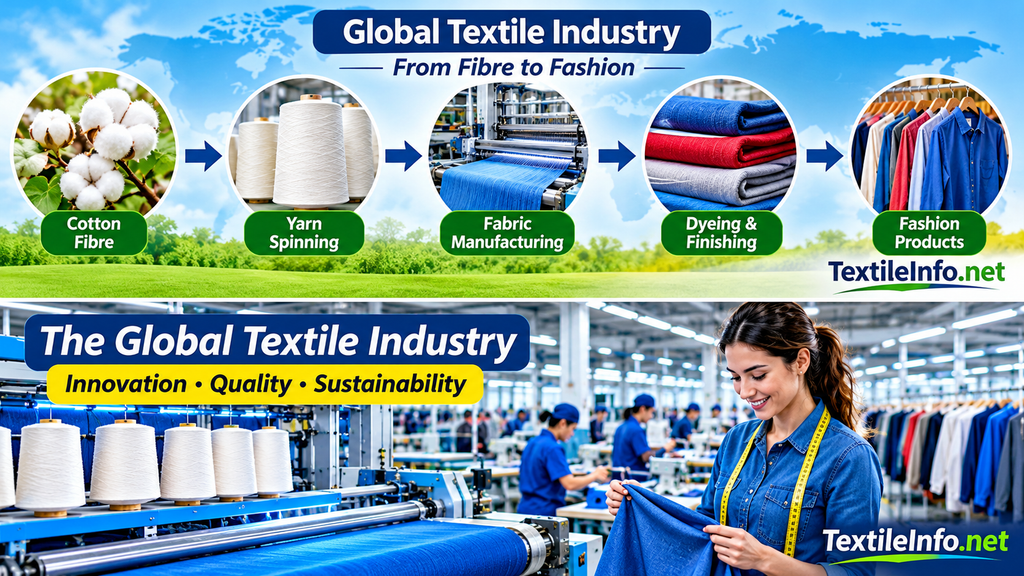
The journey begins with raw fibre production and continues through yarn manufacturing, fabric production, dyeing, finishing, garment assembly, international distribution and retail.
Every stage contributes to the quality, cost, appearance and performance of the final product.
For American and European fashion brands, textile buyers, manufacturers and consumers, understanding this process provides a clearer picture of how the global fashion and textile supply chain operates.
As sustainability, automation and digital technologies continue to develop, the textile industry will keep evolving.
The future of textiles will depend on how effectively businesses combine manufacturing innovation, responsible sourcing, product quality, and international cooperation.
TextileInfo.net is dedicated to exploring the global textile industry, helping readers understand the materials, manufacturing processes, technologies, and market developments shaping the world of textiles.