Introduction:
https://textileinfo.net/how-global-textile-industry-works/Global Textile Supply Chain: How Fabrics and Fashion Move Around the World. The clothes people wear every day have often travelled through several countries before reaching a shop. A cotton T-shirt sold in New York, a wool sweater purchased in London, or a polyester jacket displayed in Berlin may involve raw material suppliers, spinning mills, fabric manufacturers, dyeing facilities, garment factories, shipping companies, and international retailers.
This interconnected network is known as the global textile supply chain. It connects farmers, fibre producers, textile manufacturers, garment factories, fashion brands, logistics companies, and consumers across different regions.
The textile supply chain is one of the most important parts of the global fashion and manufacturing industries. It supports international trade, creates employment, and provides materials for clothing, home furnishings, medical products, automotive interiors, and many other applications.
However, the industry is changing. Businesses now face challenges involving shipping costs, sourcing risks, environmental responsibility, labour conditions, trade policies, and increasing demand for supply chain transparency.
In this article, we explore how the global textile supply chain works, which countries play important roles, what challenges businesses face, and how technology and sustainability are shaping its future.
What Is the Global Textile Supply Chain?
https://textileinfo.net/sustainable-textiles-eco-friendly-fabrics-future/The global textile supply chain is the network of businesses, people, materials, and transportation systems involved in producing and delivering textile products from their original raw materials to the final customer.
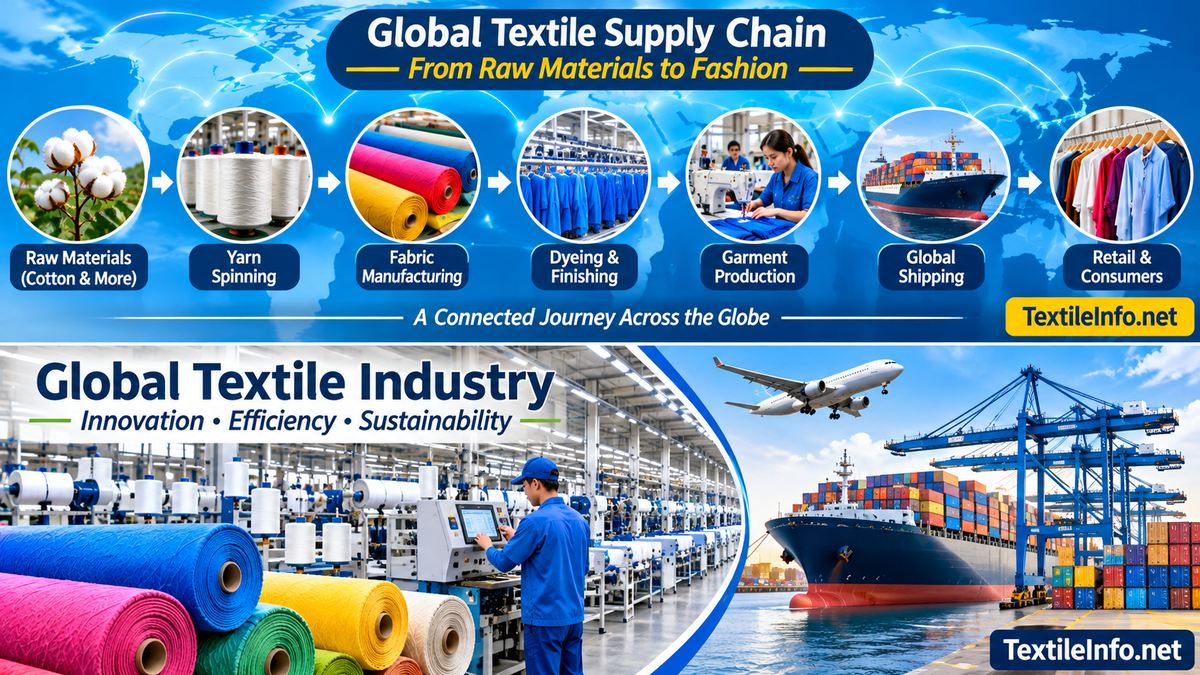
It begins with natural or synthetic fibre production and continues through yarn manufacturing, fabric production, dyeing, finishing, garment manufacturing, packaging, transportation, and retail distribution.
For example, a cotton shirt may involve cotton grown in one country, yarn spun in another, fabric woven and dyed in a third, and garment assembly in a fourth. The finished shirt may then be shipped to retailers in the United States or Europe.
This international production system allows companies to access different materials, manufacturing capabilities, technologies, and markets.
The supply chain is not always a straight line. Some products involve several suppliers and subcontractors, while others use recycled materials that re-enter the production process.
1. Raw Material Production: Where the Supply Chain Begins
https://textileinfo.net/ai-in-textile-manufacturing/Every textile product starts with raw materials. These materials are used to create the fibres that eventually become yarn and fabric.
The main categories of textile raw materials include natural fibres, synthetic fibres, regenerated fibres, and recycled fibres.
Natural fibres
Natural fibres come from plants or animals. Common examples include:
- Cotton: Widely used in T-shirts, shirts, denim, towels, and bedding.
- Wool: Commonly used in sweaters, coats, suits, and blankets.
- Silk: A premium natural fibre used in clothing, accessories, and luxury textiles.
- Linen: Produced from flax plants and valued for its breathability and durability.
- Hemp: Used in clothing, home textiles, and selected technical applications.
Cotton is particularly important to the global textile industry because it is used in a wide range of everyday products.
Synthetic fibres
Synthetic fibres are manufactured through chemical processes, often using petrochemical raw materials.
Major examples include:
- Polyester
- Nylon
- Acrylic
- Elastane
Polyester is widely used in sportswear, casual clothing, jackets, upholstery, and industrial textiles. Its durability and versatility make it an important material for manufacturers.
Regenerated and recycled fibres
Regenerated fibres are produced by processing natural or other cellulose-based materials into new fibres. Lyocell and viscose are familiar examples.
Recycled fibres are recovered from textile waste, used garments, or other suitable material streams. Recycled polyester and recycled cotton are examples.
The growing interest in recycled and lower-impact materials is encouraging companies to reconsider how they source raw materials.
2. Fibre Processing and Yarn Manufacturing
After raw materials are collected or produced, they must be processed into fibres suitable for textile manufacturing.
For cotton, this can include cleaning, opening, and carding. The fibres are then aligned and processed into yarn through spinning.
Synthetic fibres follow a different route. Polymer materials are processed into filaments or staple fibres, which can be used directly or converted into yarn.
Yarn manufacturing is an essential stage because yarn quality influences the appearance, strength, texture, and performance of the final fabric.
Common yarn production methods include:
- Ring spinning
- Open-end spinning
- Compact spinning
- Air-jet spinning
- Filament yarn production
The selection of spinning technology depends on the fibre type, required yarn characteristics, production volume, and product application.
3. Fabric Manufacturing: Weaving, Knitting and Nonwovens
Once yarn is ready, it moves to fabric manufacturing facilities.
There are three major fabric production methods.
Weaving
Weaving creates fabric by interlacing two sets of yarns, known as warp and weft.
Woven fabrics are commonly used in shirts, trousers, denim, bedsheets, jackets, and upholstery.
Knitting
Knitting creates fabric by forming interconnected loops of yarn.
Knitted fabrics are widely used in T-shirts, underwear, sweaters, sportswear, socks, and activewear because they can offer flexibility and comfort.
Nonwoven production
Nonwoven fabrics are made by bonding or mechanically interlocking fibres rather than using traditional weaving or knitting methods.
They are important in medical masks, hygiene products, filtration materials, automotive applications, and protective products.
Different manufacturing countries and mills specialise in different fabric categories. Buyers select suppliers according to quality, capacity, price, lead time, and technical requirements.
4. Dyeing, Printing and Textile Finishing
After fabric manufacturing, many materials require additional processing to achieve their final appearance and performance.
Dyeing adds colour to fibres, yarns, or fabrics. Printing applies patterns, designs, or images to textile surfaces.
Finishing processes can improve fabric characteristics such as softness, wrinkle resistance, water repellency, shrinkage control, or durability.
Important textile processing activities include:
- Fabric dyeing
- Screen and digital printing
- Washing and bleaching
- Mercerisation
- Heat setting
- Mechanical finishing
- Functional and protective finishing
These processes can have a significant effect on production costs, delivery schedules, water consumption, energy use, and chemical management.
For international buyers, consistent colour matching, fabric performance, and compliance with relevant product requirements are important considerations when selecting a textile supplier.
5. Garment Manufacturing: Turning Fabric into Clothing
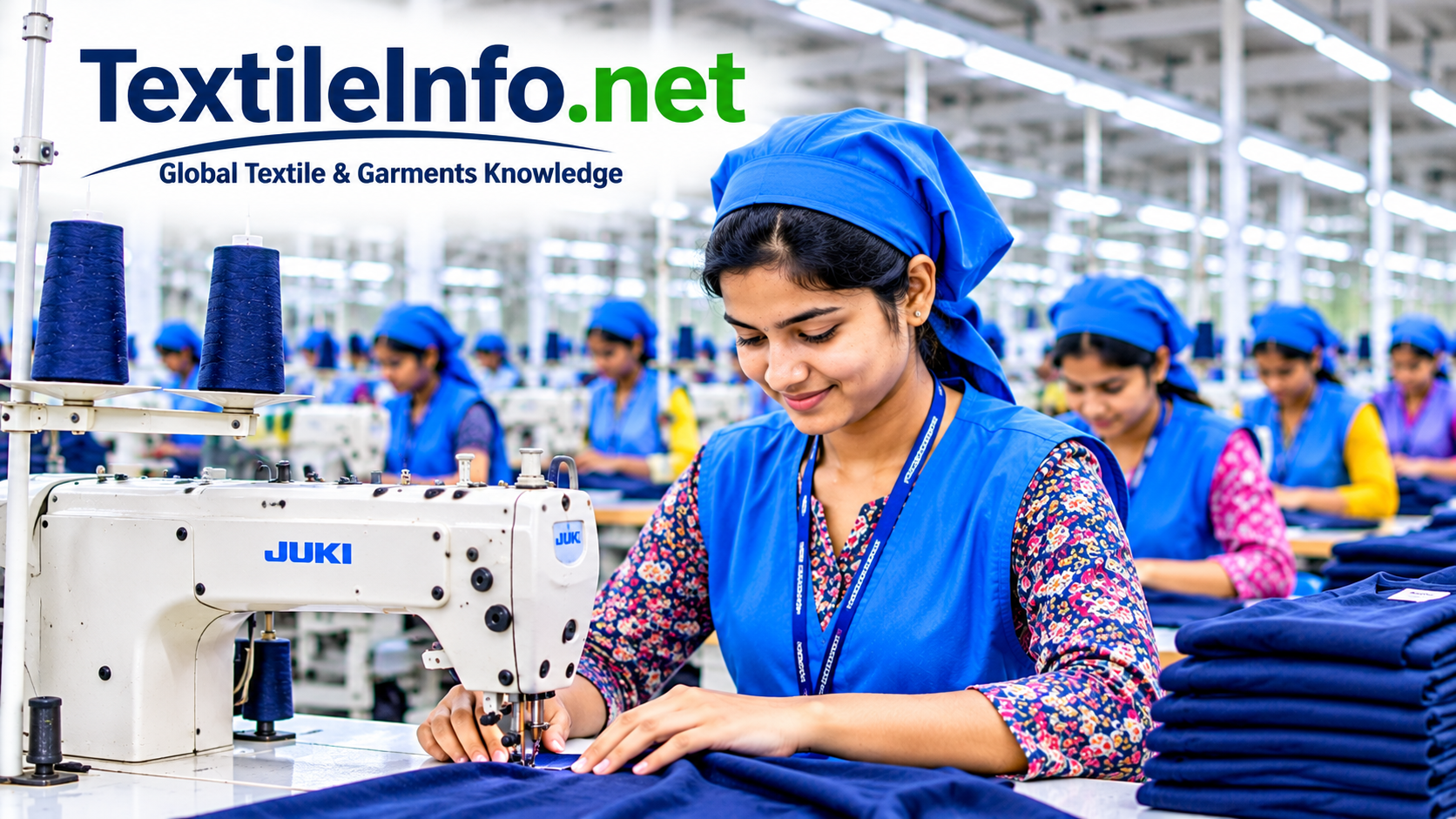
Garment manufacturing is the stage where finished fabric becomes a product that customers can purchase.
Factories receive fabric, trims, accessories, and technical specifications from buyers or sourcing partners.
The garment production process generally includes:
- Product development and sample approval.
- Fabric inspection and testing.
- Pattern making and marker planning.
- Fabric spreading and cutting.
- Sewing and assembly.
- Printing, embroidery, or other embellishment.
- Washing and finishing, where required.
- Quality inspection.
- Folding, tagging, and packaging.
A single garment can involve many components, including buttons, zippers, labels, threads, elastic, and packaging materials. These components may come from different suppliers.
This is why garment production depends on coordination between several businesses rather than only the sewing factory.
6. International Shipping and Textile Logistics
Once garments are manufactured and packed, they must be transported to international markets.
Shipping and logistics connect textile-producing countries with importers, distribution centres, wholesalers, retailers, and customers.
The main transportation methods include:
Sea freight: Commonly used for large shipments because it is generally economical for high-volume international cargo. However, transit times can be longer.
Air freight: Used for urgent deliveries, samples, high-value products, or time-sensitive orders. It is usually more expensive than sea freight.
Road and rail transport: Important for regional distribution and cross-border trade, particularly within connected manufacturing and consumer markets.
International textile shipments require accurate documentation and coordination. Depending on the shipment, this may include commercial invoices, packing lists, transport documents, certificates, customs declarations, and product-specific compliance information.
Delays at ports, customs, or transport hubs can affect delivery schedules and increase costs.
7. Retail Distribution: Reaching American and European Consumers
After arriving in the destination market, textile products move through distribution centres, wholesalers, retail stores, or direct-to-consumer businesses.
The United States and European countries are important consumer markets for clothing, footwear, home textiles, and technical textile products.
Retail businesses may sell through:
- Physical fashion stores
- Department stores
- Online marketplaces
- Independent clothing retailers
- Brand-owned e-commerce websites
- Wholesale distribution networks
Retailers must manage inventory, customer demand, seasonal trends, returns, and product availability.
For international brands, a reliable supply chain is essential to keeping products available while controlling purchasing and distribution costs.
Major Countries in the Global Textile Supply Chain
Textile production and sourcing are distributed across many countries. Each market has different strengths, including raw material availability, spinning capacity, fabric production, garment manufacturing, technical expertise, and access to international buyers.
The following countries are important participants in different parts of the textile and apparel industry.
China
China is a major global textile and apparel manufacturing centre. Its industrial ecosystem includes fibre production, spinning, weaving, knitting, dyeing, finishing, garment manufacturing, machinery, and textile accessories.
Its broad manufacturing base makes it an important sourcing destination for international brands and buyers.
India
India has a large textile industry supported by cotton production, spinning mills, weaving, processing, traditional textiles, and garment manufacturing.
It is an important supplier of cotton products, home textiles, fabrics, and apparel.
Bangladesh
Bangladesh is particularly well known for ready-made garment manufacturing and apparel exports.
Its export-oriented industry produces products such as T-shirts, shirts, trousers, sweaters, denim, and knitwear for international fashion markets.
The country’s garment sector is an important part of the global clothing supply chain, although many manufacturers depend on imported textile inputs and accessories.
Vietnam
Vietnam is an important apparel manufacturing and export destination. Its garment sector is closely connected to international sourcing networks and regional textile suppliers.
Türkiye
Türkiye has an established textile and apparel industry, with capabilities in yarn, fabrics, denim, knitwear, home textiles, and finished garments.
Its location provides access to European and nearby regional markets.
Italy
Italy is recognised for premium fabrics, luxury fashion, specialised textile manufacturing, and high-value product development.
Its textile industry is particularly important in segments where design, craftsmanship, quality, and innovation are key selling points.
United States
The United States is a major consumer market and also has domestic textile manufacturing capabilities.
Its textile sector supplies materials for apparel, home furnishings, medical applications, protective products, and industrial uses.
Germany
Germany is an important European market for technical textiles, industrial materials, machinery, research, and specialised textile applications.
These countries are examples rather than a complete ranking. The best sourcing location depends on the product, material, required quality, cost, trade conditions, and delivery requirements.
How the Global Textile Supply Chain Connects Different Countries
A useful way to understand the international supply chain is to follow a hypothetical cotton T-shirt.
- Cotton is grown and harvested in a cotton-producing country.
- The cotton is transported to a spinning mill, where it becomes yarn.
- The yarn is sent to a knitting facility to produce fabric.
- The fabric is dyed, finished, inspected, and approved.
- The fabric is delivered to a garment factory.
- The factory cuts, sews, checks, and packs the T-shirts.
- The finished garments are transported to an importing country.
- A distribution centre receives the shipment and supplies retailers.
- Consumers purchase the T-shirts through stores or online platforms.
This example demonstrates why the global textile supply chain requires cooperation between many businesses and countries.
A delay at one stage can affect the entire production schedule. If yarn delivery is late, fabric production may be delayed. If fabric approval takes longer than expected, garment production and shipping may also be affected.
Major Challenges Facing the Global Textile Supply Chain
Although international sourcing gives companies access to a wide range of suppliers, it also creates risks.
1. Shipping delays and transportation costs
International textile businesses depend on reliable transportation.
Port congestion, container shortages, route disruptions, fuel costs, and unexpected delays can affect delivery schedules.
For fashion brands, late shipments may result in missed seasonal sales opportunities or additional inventory costs.
2. Raw material price fluctuations
Cotton, polyester, wool, chemicals, energy, and other inputs can experience price changes.
These fluctuations make it difficult for manufacturers and buyers to maintain stable production costs.
Companies often manage this risk through supplier diversification, purchasing strategies, and long-term relationships.
3. Geopolitical and trade uncertainty
International trade policies, tariffs, sanctions, conflicts, and changing customs requirements can affect sourcing decisions.
Businesses that rely heavily on one country or one supplier may face greater exposure when trade conditions change.
4. Labour rights and working conditions
The textile and garment industry involves a large workforce across multiple production stages.
Businesses need to consider worker safety, fair employment practices, working hours, wages, and other labour-related risks.
Responsible sourcing requires more than checking the final factory. Companies should understand the suppliers and subcontractors involved in producing their materials and products.
5. Environmental impact
Textile production can involve significant water, energy, chemical, and material use.
Dyeing and finishing operations require careful environmental management. Synthetic garments can also release microfibres during washing.
Companies are increasingly expected to understand and reduce environmental impacts throughout the supply chain.
6. Lack of supply chain transparency
Some brands have detailed information about their direct manufacturers but limited visibility into deeper supplier levels.
This makes it difficult to confirm where raw materials originated, which facilities processed them, and what environmental or labour conditions were involved.
The United Nations Environment Programme has highlighted the difficulty of achieving transparency and traceability across the textile value chain, including limited disclosure beyond direct suppliers.
Sustainability and the Future of Textile Supply Chains
Sustainability is becoming an important factor in textile sourcing and manufacturing decisions.
Fashion brands, retailers, manufacturers, and consumers are paying more attention to material selection, production methods, product durability, waste management, and recycling.
Several developments are influencing the future of the industry.
Sustainable raw material sourcing
Companies are exploring organic cotton, recycled polyester, recycled cotton, hemp, linen, and responsibly produced cellulosic fibres.
However, material claims should be supported by reliable supplier information and appropriate verification.
Water and energy efficiency
Textile processing facilities can improve resource efficiency through modern machinery, better process control, water reuse, wastewater treatment, and energy management.
These measures can help reduce operating costs as well as environmental impacts.
Textile recycling
Recycling can help recover materials from production waste and used textiles.
Mechanical recycling is already used for certain fibre types, while chemical recycling technologies are being developed and expanded for selected materials.
A major challenge is producing recycled fibres that meet the quality and performance requirements of new textile products.
Circular fashion
Circular textile systems aim to keep materials and products in use for longer.
Examples include clothing repair, resale, reuse, fibre recovery, and designing garments that are easier to recycle.
The European Union’s Sustainable and Circular Textiles Strategy supports a broader transition towards more durable, repairable, and recyclable textile products.
How Technology Is Transforming Textile Supply Chain Management
Technology is helping textile companies improve production planning, supplier communication, quality control, and shipment visibility.
Artificial intelligence
AI can help manufacturers forecast demand, identify production problems, inspect fabric quality, and improve inventory planning.
For example, AI-supported inspection systems can identify certain fabric defects more consistently and quickly than manual inspection alone.
Digital supply chain platforms
Digital platforms help businesses exchange orders, production updates, shipping documents, quality reports, and supplier information.
This can reduce communication gaps between brands, factories, and logistics partners.
Blockchain and product traceability
Blockchain technology can provide a shared record of selected supply chain transactions.
When supported by reliable data collection and verification, it may help businesses track materials and product movements.
However, blockchain does not automatically guarantee that the information entered into a system is accurate.
Digital Product Passports
The European Union is developing a regulatory framework for Digital Product Passports under its sustainable product policy.
Digital product information is intended to support transparency and provide relevant information about products, materials, and sustainability characteristics.
Textile businesses selling into Europe should monitor applicable requirements and implementation timelines rather than assume that every product is already subject to the same passport obligations.
How Textile Companies Can Build a More Resilient Supply Chain
A resilient supply chain can respond more effectively to unexpected disruptions while maintaining product quality and customer service.
Textile manufacturers, exporters, and fashion brands can take several practical steps.
1. Diversify suppliers: Avoid depending entirely on one supplier or production location when alternative qualified sources are available.
2. Improve supplier relationships: Maintain regular communication with suppliers and share realistic production forecasts.
3. Monitor production schedules: Track raw material delivery, fabric production, garment manufacturing, quality approval, and shipment milestones.
4. Strengthen quality control: Establish clear specifications and inspection procedures at important production stages.
5. Improve traceability: Maintain records of material origins, processing facilities, subcontractors, and relevant certifications.
6. Use digital tools: Adopt suitable systems for order tracking, inventory management, production planning, and supplier communication.
7. Assess environmental and social risks: Evaluate supplier performance and establish improvement plans where problems are identified.
These practices can help businesses manage costs, reduce uncertainty, and build stronger international partnerships.
The Future of the Global Textile Supply Chain
The global textile supply chain will continue to evolve as technology, consumer expectations, trade policies, and environmental requirements change.
Several trends are likely to influence the industry in the coming years.
- More diversified sourcing: Brands may continue evaluating alternative manufacturing countries and regional supplier networks.
- Greater traceability: Buyers will increasingly seek reliable information about materials, suppliers, and production processes.
- Smart manufacturing: Automation, artificial intelligence, and digital systems will play a larger role in production management.
- Circular production: Recycling, reuse, repair, and material recovery will become more important parts of textile business models.
- Technical textiles: Demand for specialised materials in healthcare, automotive, construction, filtration, and protective applications will create opportunities for manufacturers.
- More responsible sourcing: Environmental performance and labour practices will remain important considerations for international buyers.
Companies that invest in quality, transparency, technology, and responsible production will be better positioned to respond to changing market expectations.
Conclusion
The global textile supply chain is a complex international network that connects raw material producers, fibre processors, spinning mills, fabric manufacturers, garment factories, shipping companies, retailers, and consumers.
Every stage plays an important role in delivering textile products to markets around the world.
For American and European brands, understanding this network is essential for making informed sourcing decisions, controlling costs, improving product quality, and managing supply chain risks.
For manufacturers and exporters, opportunities will increasingly depend on reliable production, competitive pricing, transparent supplier relationships, and the ability to meet changing customer and market requirements.
As sustainability and technology reshape the textile industry, the global textile supply chain is moving towards a more connected, transparent, and resource-conscious future.